
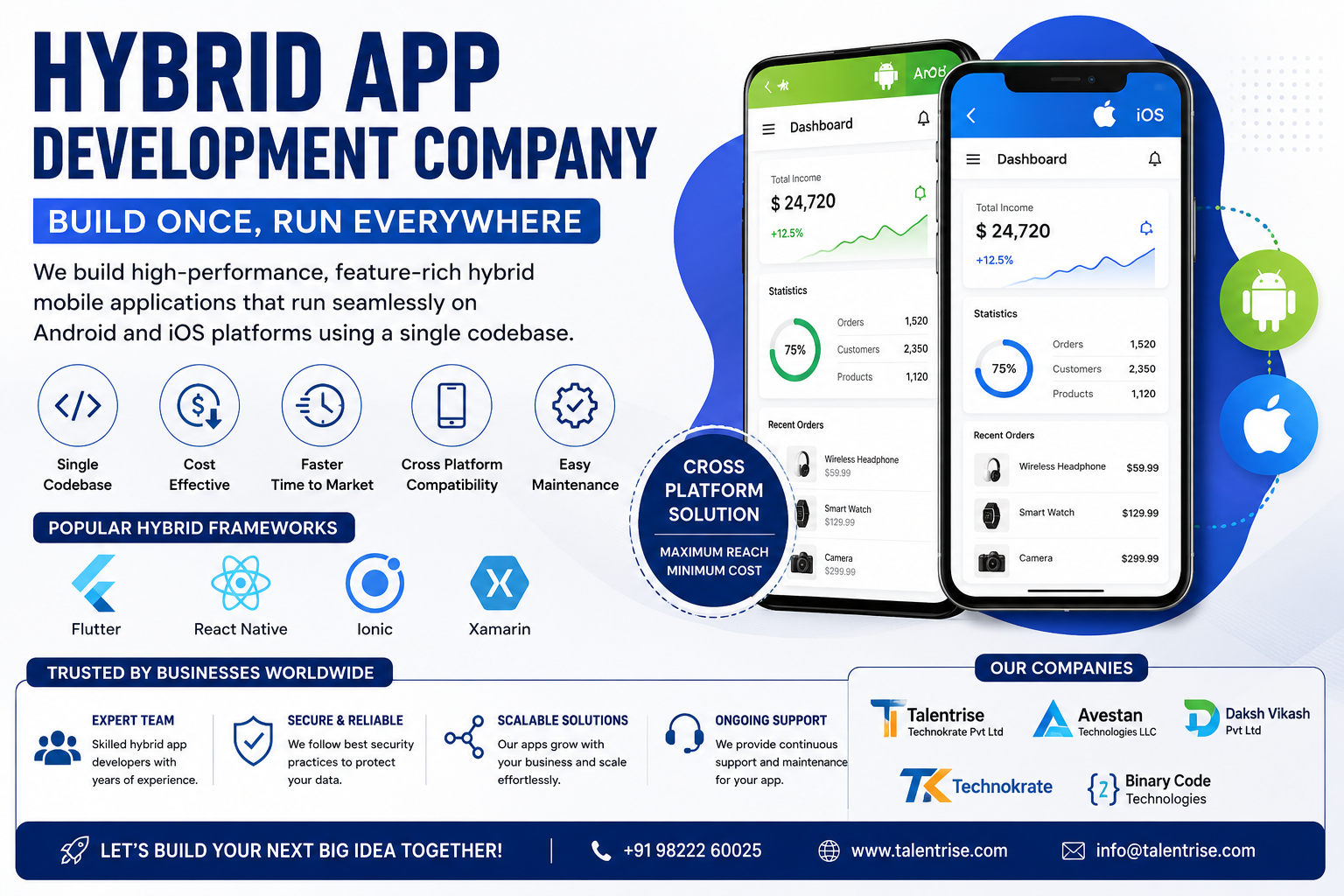
In today’s competitive digital landscape, businesses are looking for faster, more efficient, and cost-effective ways to reach their customers. Mobile applications have become an essential tool for business growth, customer engagement, and brand visibility. However, developing separate applications for Android and iOS can be expensive and time-consuming. This is where a Hybrid App Development Company plays a crucial role.
Hybrid app development allows businesses to create a single application that works seamlessly across multiple platforms, including Android and iOS. By leveraging modern frameworks such as Flutter, React Native, and Ionic, companies can reduce development costs while delivering high-performance mobile experiences.
What is Hybrid App Development?
Hybrid app development is the process of building a mobile application using a single codebase that can run on multiple operating systems. Unlike native apps that require separate development for Android and iOS, hybrid apps use web technologies such as HTML, CSS, and JavaScript combined with powerful frameworks to create cross-platform applications.
This approach enables businesses to launch applications faster while maintaining consistent functionality and user experience across devices.
Why Businesses Choose Hybrid App Development
Organizations of all sizes are adopting hybrid mobile applications due to their flexibility and affordability. Hybrid apps provide an ideal solution for startups, small businesses, and enterprises looking to maximize their return on investment.
Some key benefits include:
Reduced Development Costs
Developing one application for multiple platforms significantly lowers development expenses compared to creating separate native applications.
Faster Time to Market
A single codebase enables developers to build and deploy applications more quickly, helping businesses launch products faster.
Easier Maintenance
Updates and bug fixes can be implemented once and deployed across all platforms simultaneously.
Consistent User Experience
Hybrid applications provide a uniform interface and functionality across Android and iOS devices.
Wider Market Reach
Businesses can target a broader audience by supporting multiple operating systems with a single application.
Key Features of Hybrid Mobile Applications
Modern hybrid applications offer advanced features that meet evolving customer expectations.
Cross-Platform Compatibility
Applications run smoothly on Android, iOS, tablets, and other mobile devices.
Cloud Integration
Hybrid apps can seamlessly connect with cloud-based services for data storage and synchronization.
Offline Functionality
Users can access essential features even without an internet connection.
Push Notifications
Businesses can engage customers through personalized notifications and real-time updates.
Enhanced Security
Modern frameworks incorporate secure authentication and data protection mechanisms.
API Integration
Hybrid applications can easily integrate with third-party services such as payment gateways, CRM systems, and analytics tools.
Popular Hybrid App Development Frameworks
Flutter
Flutter, developed by Google, enables developers to create visually appealing and high-performance applications using a single codebase.
React Native
React Native is a widely used framework that allows developers to build scalable applications with near-native performance.
Ionic
Ionic is ideal for developing feature-rich applications using web technologies and reusable components.
Xamarin
Xamarin supports cross-platform development while providing native-like performance and functionality.
Industries Benefiting from Hybrid App Development
Hybrid mobile applications are transforming businesses across multiple industries.
Ecommerce
Online retailers use hybrid apps to provide seamless shopping experiences across devices.
Healthcare
Healthcare providers leverage mobile applications for appointment scheduling, telemedicine, and patient management.
Finance
Financial institutions utilize secure hybrid applications for digital banking and payment services.
Education
Educational platforms use mobile apps for online learning, virtual classrooms, and student engagement.
Logistics
Logistics companies benefit from real-time tracking, inventory management, and route optimization.
Food Delivery
Restaurants and food delivery services use mobile applications to streamline ordering and delivery processes.
Hybrid App Development Process
A professional Hybrid App Development Company follows a structured development process to ensure project success.
Requirement Analysis
The development team evaluates business objectives, target audience, and technical requirements.
UI/UX Design
Designers create intuitive and engaging interfaces that enhance user experience.
Development
Developers build the application using modern hybrid frameworks and best coding practices.
Testing and Quality Assurance
Comprehensive testing ensures application performance, security, and compatibility across devices.
Deployment
The application is published on Google Play Store and Apple App Store.
Ongoing Support and Maintenance
Continuous updates and technical support ensure long-term success and reliability.
Why Choose Professional Hybrid App Development Services?
Partnering with an experienced development company ensures access to skilled developers, advanced technologies, and industry expertise. Professional teams focus on delivering scalable, secure, and future-ready applications that align with business goals.
Companies such as Talentrise Technokrate Pvt Ltd, Avestan Technologies LLC, Daksh Vikash Pvt Ltd, Technokrate, and Binary Code Technologies have contributed to the growing demand for innovative mobile application solutions by helping businesses adopt modern app development strategies.
Future of Hybrid Mobile Applications
The future of hybrid app development is driven by emerging technologies such as Artificial Intelligence (AI), Internet of Things (IoT), Blockchain, Machine Learning, and Cloud Computing. These technologies enable businesses to build smarter, faster, and more personalized mobile experiences.
As mobile usage continues to increase globally, hybrid app development will remain a preferred choice for organizations seeking cost-effective and scalable digital solutions.
Conclusion
Choosing a reliable Hybrid App Development Company can help businesses accelerate digital transformation while minimizing development costs. Hybrid applications provide flexibility, scalability, and faster deployment, making them an excellent investment for startups, SMEs, and enterprises.
With modern frameworks and experienced development teams, businesses can build feature-rich applications that deliver exceptional user experiences across multiple platforms. Whether you are launching a new product or modernizing an existing application, hybrid app development offers the perfect balance between performance, affordability, and scalability.
Frequently Asked Questions (FAQs)
What is a hybrid mobile application?
A hybrid mobile application is a single application that works on multiple platforms such as Android and iOS using a shared codebase.
Is hybrid app development cheaper than native app development?
Yes, hybrid app development is generally more cost-effective because one codebase is used for multiple platforms.
Which framework is best for hybrid app development?
Popular frameworks include Flutter, React Native, Ionic, and Xamarin.
Can hybrid apps deliver native-like performance?
Modern frameworks such as Flutter and React Native provide near-native performance and excellent user experiences.
Why should businesses choose hybrid app development?
Hybrid app development reduces costs, accelerates deployment, simplifies maintenance, and expands market reach.
