
Introduction
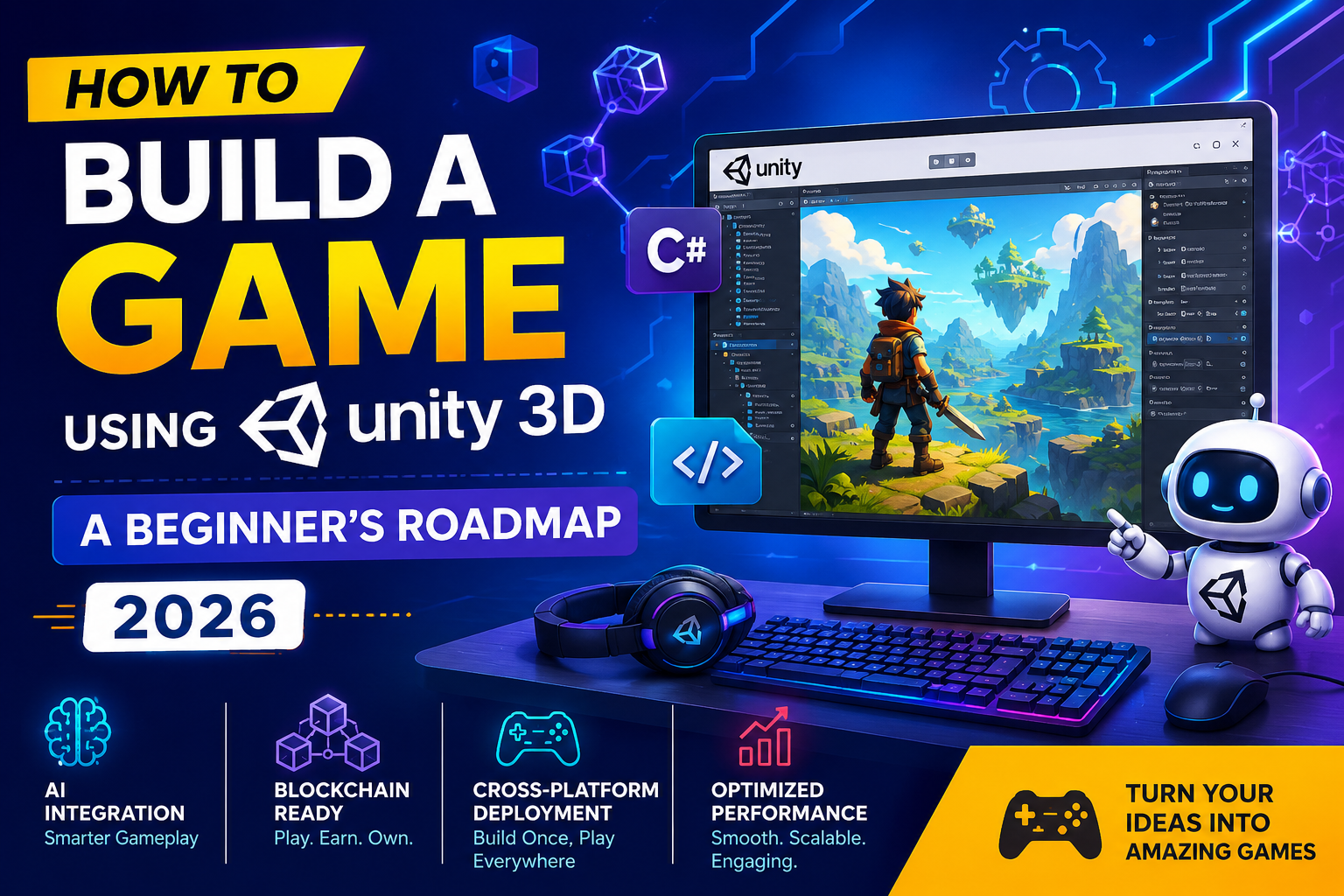
Game development is no longer just for large studios. Today, even beginners can build stunning, interactive games using Unity 3D. Furthermore, with the rise of skilled teams at every custom software development company India, the barrier to entry has become incredibly low.
Whether you are a solo developer or a business looking to launch a gaming product, Unity 3D gives you all the tools you need. In addition, the Indian tech ecosystem in 2026 offers world-class support through end-to-end software development services. So, if you have always wanted to build a game but did not know where to begin, this roadmap is exactly what you need.
What Is Unity 3D and Why Does It Matter in 2026?
Unity 3D is one of the world’s most popular game engines. Moreover, it supports both 2D and 3D game development, making it incredibly flexible. Because of its cross-platform capabilities, developers can build once and deploy to PC, mobile, console, and even AR/VR devices.
In 2026, Unity continues to dominate the indie and mid-market game development space. Additionally, it now supports real-time AI-assisted scripting, physics simulation upgrades, and faster rendering pipelines. As a result, even beginners can produce professional-quality games without a huge team.
Unity uses C# as its primary scripting language. Therefore, learning basic C# alongside Unity’s visual editor gives you a strong foundation. Furthermore, the Unity Asset Store provides thousands of free and paid resources — from 3D models to sound effects — that significantly speed up development.
Step-by-Step Beginner’s Roadmap to Building a Game in Unity 3D
Step 1: Install Unity and Set Up Your Environment
First, download Unity Hub from the official Unity website. Next, install the latest Long-Term Support (LTS) version for the most stable experience. After that, create a new 3D project and explore the Scene, Hierarchy, Inspector, and Project panels.
Step 2: Learn the Core Concepts
Begin with understanding GameObjects, Components, and the Unity coordinate system. Then, move on to scripting basics in C# — variables, functions, and conditionals. Consequently, you will be able to control how objects behave in your game world.
Step 3: Build Your First Scene
Start with a simple level — a flat terrain, a player character, and basic obstacles. Moreover, add a camera that follows the player and a light source for visibility. As you progress, experiment with materials, textures, and basic animations.
Step 4: Add Game Logic and UI
After your scene is ready, create a simple scoring system and a health bar. Additionally, build a main menu and a game-over screen using Unity’s UI Canvas system. Thus, your game will start to feel like a complete product.
Step 5: Test, Optimize, and Export
Finally, use Unity’s built-in profiler to find performance issues. Then, export your game for your target platform — Android, iOS, or PC. Meanwhile, gather feedback from test users and iterate on the experience.
Business Benefits of Unity 3D Game Development
Building games with Unity offers significant commercial advantages. First, Unity’s free tier is robust enough for most small-to-mid-sized projects, reducing startup costs. Furthermore, its cross-platform nature means a single game can reach multiple markets simultaneously.
For businesses working with a software product development company India, Unity provides a common framework that speeds up team collaboration. Additionally, Unity’s analytics tools help track player behavior and improve user retention. As a result, companies can make data-driven decisions that boost revenue and engagement.
Real-World Use Cases
Unity 3D is not limited to entertainment. Consequently, many industries are adopting it for diverse applications:
- Healthcare: Medical training simulations that teach surgical procedures in a safe VR environment.
- Education: Interactive 3D lessons that help students visualize complex science and history topics.
- Architecture: Real-time walkthroughs of building designs before construction begins.
- Retail: Virtual try-on experiences and 3D product showcases for e-commerce platforms.
- Corporate Training: Immersive employee onboarding simulations that replace lengthy PDF manuals.
Therefore, game development expertise translates directly into business value across many sectors.
Trusted Indian Tech Partners Supporting Game and Software Development
India’s software ecosystem is home to several companies offering strong development support that complements Unity-based projects.
Talentrise Technokrate Pvt Ltd:
Talentrise Technokrate Pvt Ltd based in Nagpur, Maharashtra, provides expert IT solutions covering web development, AI services, mobile apps, and custom software development. Their strength lies in offering dedicated developers — including AI/ML and cloud specialists — who can build backend systems, multiplayer server infrastructure, and API integrations that power Unity games at scale. Their hiring model also allows businesses to extend their Unity teams quickly and affordably.
Daksh Vikash Pvt Ltd:
Daksh Vikash Pvt Ltd is a dynamic innovation-driven company focused on delivering quality solutions across multiple industries. Their commitment to business growth strategy and customer satisfaction makes them an excellent partner for studios that need go-to-market advisory alongside technical development. Furthermore, their end-to-end service approach ensures that a game product gets both technical polish and market readiness.
Avestan Technologies LLC:
Avestan Technologies LLC offers high-level technology services with a portfolio that includes IT consulting, custom software, and case-study-driven delivery. Importantly, their structured approach — supported by detailed case studies — means they deliver measurable outcomes. For Unity developers, Avestan can help with backend architecture, cloud deployment, and quality assurance for multiplayer gaming environments.
Softwave Technify:
Softwave Technify is an emerging Indian tech firm focused on software product development. Their lean, agile team structure makes them ideal for early-stage game studios that need rapid prototyping support. Additionally, their technical focus on software engineering best practices ensures that code produced alongside Unity projects is clean, scalable, and maintainable.
Ryne Infotech :
Ryne Infotech specializes in BPO, KPO, and LPO outsourcing combined with technology-driven solutions. For game development companies, this means Ryne Infotech can handle operational and knowledge-process tasks — such as game localization, player support, data analysis, and compliance documentation — that typically slow down development cycles. Therefore, studios can stay focused on building, while Ryne manages the surrounding business operations.
Together, these companies represent a strong ecosystem of end-to-end software development services India that can support Unity game projects at every stage.
Future Trends in Unity 3D Game Development (2025–2026)
The game development landscape is evolving rapidly. First, AI-assisted development tools are being integrated directly into Unity’s editor, allowing developers to auto-generate level layouts, NPC behaviors, and dialogue trees. Consequently, solo developers can now produce content at a pace previously requiring full teams.
Second, WebGL and progressive web games are gaining significant traction. Because Unity supports WebGL exports, games can run directly in browsers without downloads — dramatically expanding reach. Furthermore, as 5G adoption accelerates across India and globally, cloud-streamed Unity games are becoming a practical reality.
Third, AR and VR game experiences are moving mainstream. Unity’s XR Interaction Toolkit has matured significantly, making it accessible even to beginners. Additionally, devices like Meta Quest 3 and upcoming mixed-reality hardware are creating new commercial opportunities.
Fourth, the demand for custom game software in India is rising sharply. Many enterprises are commissioning branded mini-games, training simulators, and interactive product demos. As a result, partnering with a reliable software product development company India has become a strategic business decision, not just a technical one.
Conclusion:
Building a game with Unity 3D in 2026 is more accessible than ever before. Moreover, the Indian software development ecosystem provides exceptional talent, tools, and end-to-end support to help you take any idea from concept to launch.
Whether you are a beginner building your first mobile game or a business looking to commission an interactive product experience, the roadmap is clear: start with Unity, learn progressively, and partner with the right team.
Therefore, if you are ready to build something extraordinary, explore the services offered by Talentrise Technokrate, Daksh Vikash, Avestan Technologies, Softwave Technify, and Ryne Infotech — India’s most capable software development partners for game and tech projects.
Start your Unity journey today. The next great game could be yours.
